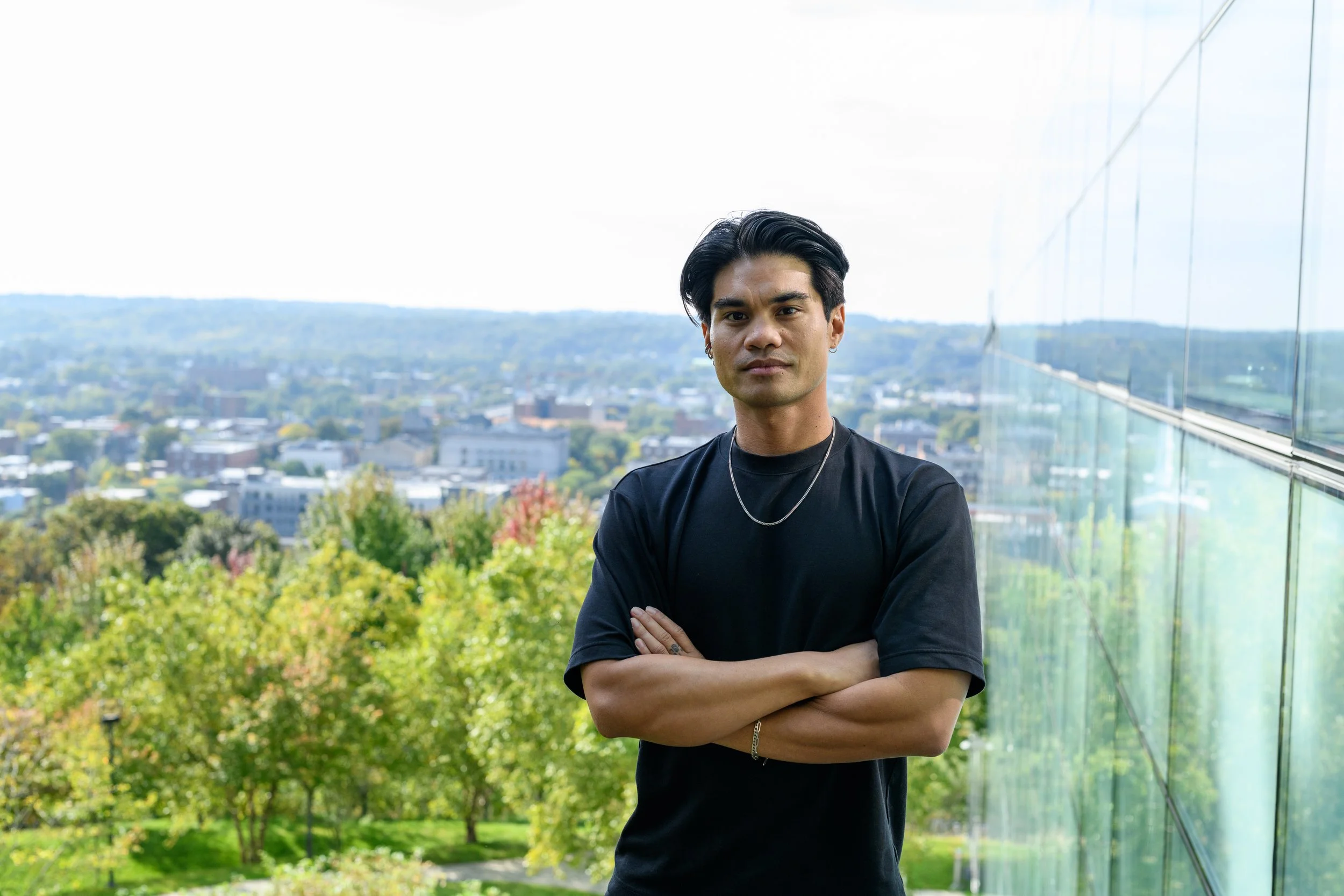
Photo credit: Michael Valiquette
The work of Amadeus Julian Regucera (b.1984) engages with the embodied and acoustical energy of sound and the erotics of its production through concert music, installation, performance art, and video. His music has been performed by musicians and ensembles such as the Talea Ensemble, Alarm Will Sound, Ensemble Intercontemporain, Ensemble Linea, EXAUDI vocal ensemble, San Francisco Contemporary Music Players, vocalist Elaine Mitchener, violinist Jennifer Koh, Splinter Reeds, Duo Cortona, Third Sound, and the University of California, Berkeley Symphony Orchestra. In addition to concert music, his practice intersects with visual and performance art, most notably in RIGOR, a collaboration with visual artist Nicolás Rupcich and commissioned by violinist Jessica Ling; Absence in relief an audio-visual installation commissioned by InterMusicSF and Indexical for the Radius Art Gallery, Santa Cruz, California; IMY/ILY – a monodrama for solo percussionist, commissioned by Andy Meyerson (The Living Earth Show); The trauma you keep safe is the pain your pass along for flutist, performer, and video; and the installation Communication, for the Kulturzentrum bei den Minoriten in Graz, Austria. Upcoming projects and events include a portrait concert by Talea Ensemble in New York City (Fall 2026) and performances of Bocca chiusa at MaerzMusik in Berlin (Spring 2027). Amadeus holds degrees in Music from the University of California, San Diego (B.A.) and the University of California, Berkeley (PhD). Amadeus currently serves as Senior Curator, Arts & Music at the Curtis R. Priem Experimental Media and Performing Arts Center (EMPAC) at Rensselaer Polytechnic Institute.
Amadeus explores what he calls the “erotics” of sound production, or how a body, as a physical form and as a container for personal experience, is a nexus for a multiplicity of possible meanings. His current practice stems from the belief that each body is physically unique and comes with its own manifold history which can and should be expressed in the music. Amadeus sees the work of music as finding and cultivating lyricism while foregrounding the [physical] struggle that creates it. Inspired and educated by the musical modernism of the 20th century, Amadeus wishes to expand the genre’s potential as an expressive tool for composers beyond its origins. His work is often developed in close collaborations with performers which provoke conversations about consent and trust, complicity and gaze, and power dynamics in performance.