In Empty (2025)
after Theresa Hak Kyung Cha
voice, alto saxophone, violin
written for Duo Cortona and Geoffrey Deibel
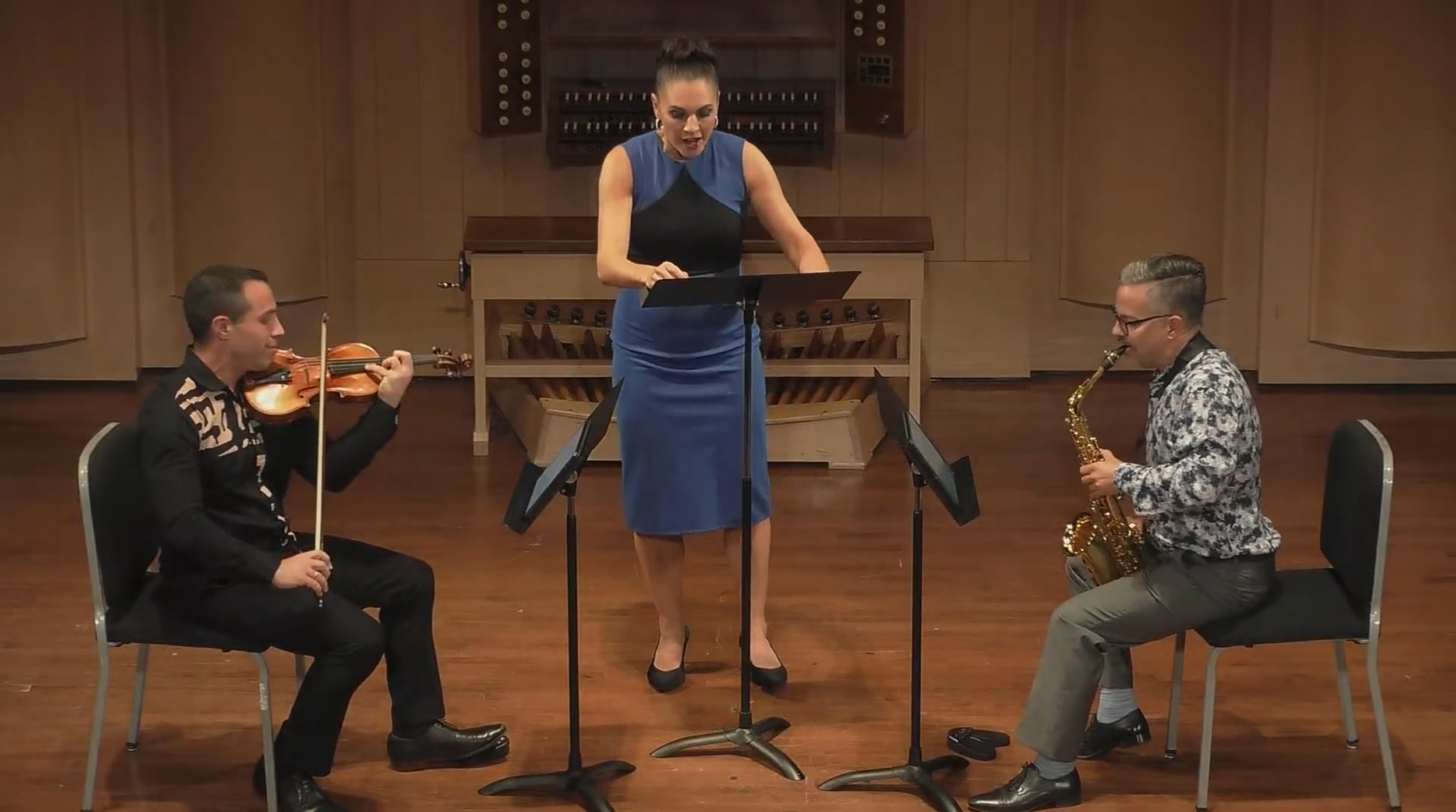
Duo Cortona & Geoffrey Deibel performing In Empty at the University of South Carolina.
A note to the performers:
The piece, in two parts attacca, is preoccupied with flow and momentum, a breathlessness that borders on exhaustion. This is apparent in the relentless musical information, the chiseled rhythms, the strict tempo. There are moments to collect as performers, tho; at the rehearsal marks, time can be taken to regroup or rest; we can decide together (or you can as a trio) how much time might be needed or not. The sound of the piece should be delicate; at one point, in my manuscript, I had written that I wanted the music to be “carved out of air…”—I think this is still an apt performative description. The first part (mm. 1-201) is composed of music that has weight and substance, the text by poet/author/visual artist/filmmaker Theresa Hak Kyung Cha (more about her below), is set somewhat traditionally and guides the music—pushes the music—from “go.” The second part, “In Empty,” (mm. 202-381) takes all of the music of the first part and empties it out, pitch is largely evacuated or extinguished, the words are abstracted to intelligible utterances by the voice; the breathlessness of the first part is taken literally here in the second. The music throughout, and precisely in the second part, is homophonic—some drift (“drifting” apart from one another) between performers into heterophony is ok if not even desirable (especially in the second part). More precision in the first part is desirable for me but drift is ok.
Notationally, the noteheads match timbres across performers: open triangle noteheads denote airy, whispy, relatively unpitched sound—all that remains is contour and energy (breathy vocalizations for Rachel; air sounds for Geoff; col legno tratto for Ari, etc.); normal noteheads denote regularly performed sound; x-noteheads denote noise, again, relatively unpitched (spoken text or vocalized utterances for Rachel, slap tongue for Geoff, muted scratch for Ari, etc.).
Theresa Hak Kyung Cha (b. 1951, Korea) is a Korean-American artist whose practice spanned poetry and prose but also visual art and moving image. She is most widely known for her 1982 text Dictée, which “incorporates family history, autobiography, accounts of female martyrdom, poetry, and images. In this single text, Cha put forth all of her major themes—language, memory, displacement, and alienation…” (Constance M. Lewallen, “Audience Distant Relative: An Introduction to the Writings of Theresa Hak Kyung Cha”). I chose Cha’s untitled poem i have time because of its preoccupation with temporality, though a kind of time that unites the infinite (through the lens of religion) with the mundane (“recipe for salade niçoise”). In the poem, one can sense the ticking of a timepiece—though irregular—as she pivots from lists of household items or bodily organs (“the scattered alchemy of these materials”), to prayer (“hallowed be thy name”), to mysterious quasi-religious, profound imagery (“the violet mist hovering the cemeteries the tombstones pinnacle to god the father god the son god the holy spirit”): the elision of these poetic subjects mirror the velocity and urgency of the music I wrote. [There is anxiety (again, urgency) in her use of poetic repetition (“i have time”).]
The other reason I chose Hak Kyung Cha is because of her abstraction of language itself—a process that lends itself to the process of musical composition as well as the practice of translating the written text/score to performance—Cha was “looking for the roots of the language before it is born on the tip of the tongue…As a foreigner, learning a new language extended beyond its basic function as communication as it is general for a native speaker, to a consciously imposed detachment that allowed analysis and experimentation with other relationships of language.” In the second part of this sentence, I find not only my relationship with sounds and their composition but also your role as performers in interpreting my musical language: “learning a new language extended beyond its basic function.” With this piece, we’re learning a new language together.
Special thank you to the Berkeley Art Museum/Pacific Film Archive for the generous permission for the use of Theresa Hak Kyung Cha’s work. The poem, “I have time” can be found in Exilée and Temps Morts: Selected Works. Constance Lewallen, ed. Berkeley: University of California Press, 2009.